I’m going to tell you something that might surprise you: I generate AI videos with synchronized audio every single day, and I don’t own an NVIDIA GPU.
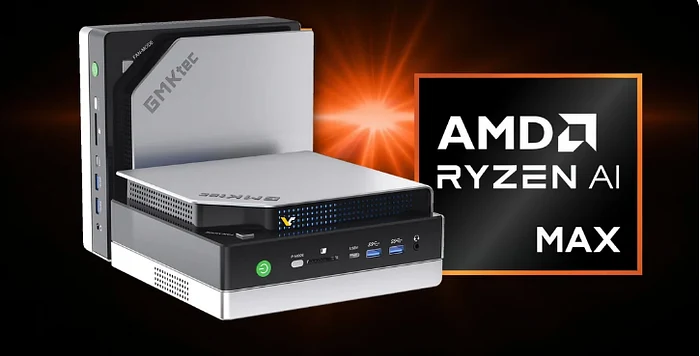
I run a Strix Halo APU. That’s AMD’s newest chip with 128GB of unified memory in a tiny NUC form factor. And it runs LTX-2, one of the most advanced open-source video generation models, beautifully. Ten-second talking videos with native audio sync in about ten minutes.
No CUDA. No Jensen. No $2000 graphics card.
Let me be clear about what this is and isn’t. This isn’t a benchmark war. I’m not here to argue that AMD is faster than NVIDIA. On raw performance, NVIDIA still wins most comparisons. What I’m saying is simpler: AMD works. For real workflows. Every day.
The Hardware
I run a GMTEK NUC EVO 2 with the Strix Halo APU. It’s got the Radeon 8060S graphics and 128GB of unified memory that I can split however I want between system RAM and VRAM. Right now I run 64GB for each. The whole thing sits on my desk and barely makes noise.
For context, NVIDIA doesn’t make anything like this at this price point. Their consumer cards top out at 32GB VRAM, and you need to build a whole desktop around them. Enterprise cards with more memory cost thousands and require serious cooling.
NVIDIA does make a comparable product: the DGX Spark. It’s their answer to high-memory AI compute in a small form factor. It costs roughly twice what my Strix Halo system cost, and here’s the kicker: you’re locked into NVIDIA’s ecosystem. Their software stack. Their licensing terms. Their roadmap.
The Strix Halo gives me up to 96GB of usable VRAM in something the size of a hardcover book, running standard Linux, with no vendor lock-in.
The Software Reality
Here’s where I have to be honest. Getting this working wasn’t plug and play.
The official ROCm stack from AMD is currently at version 7.2. It works, but it’s slow on this chip. What actually makes Strix Halo sing is something called TheROCk.
Here’s what most people don’t realize: TheROCk isn’t a community fork. It’s AMD’s official next-generation stack. TheROCk started at version 7.9 while ROCm was still at 7.2. It’s currently at 7.11. In March 2026, TheROCk becomes ROCm 8.0, and the old ROCm branch gets deprecated. AMD is actively developing this. The nightlies I’m running aren’t unofficial builds from enthusiasts; they’re AMD’s own preview releases of what’s coming.
The difference in performance between ROCm 7.2 and TheROCk 7.11 is dramatic. Same hardware, completely different experience.
I also had to figure out some environment variables through trial and error. There are two settings, HSA_ENABLE_SDMA and HSA_USE_SVM, that need to be disabled or the APU will hang or crash randomly. Nowhere is this documented officially. I learned it from forum posts and crashes.
The power management tools that ship with ROCm don’t work properly on APUs either. I use a third-party tool called CoreCtl to make sure the chip actually runs at full speed instead of staying throttled in low-power mode.
And just this week, I discovered that ComfyUI has a bug where audio tensors don’t get moved to CPU memory before saving. It works on NVIDIA by accident due to how their memory is handled. On AMD, it crashes. I had to patch one line of Python to fix it.
This is the reality of running AMD for AI work right now. The hardware is genuinely capable. The software requires effort.
What Actually Works
Let me list what I’ve personally tested and use regularly on this setup.
LTX-2 works fully. This is Lightricks’ new audio-video model that generates talking characters with synchronized speech. It’s genuinely impressive technology and it runs great on Strix Halo once you have the environment configured.
Flux works for image generation. Fast and stable. SDXL works, also fast and stable. Hunyuan Video works for video generation, though it’s slower than LTX-2. Z Turbo works for fast image generation.
SimpleTuner works for local LoRA training. This means I can train custom models on the APU without renting cloud compute. That’s a big deal.
I’m not guessing about any of this. I run these workflows daily for actual content production.
A Typical Day
Here’s what my workflow actually looks like.
I start CoreCtl and make sure the APU is in performance mode. Then I launch ComfyUI with my startup script that sets all the necessary environment variables. I load an image of a character I’ve generated, write a prompt describing what I want them to say and do, and hit run. Ten to thirteen minutes later, I have a video with the character talking, moving naturally, with synchronized audio.
The quality is good enough for social media content. The turnaround is fast enough for iteration. And I’m not paying three dollars an hour to rent an H100 from a cloud provider.
Could I get faster results on high-end NVIDIA hardware? Absolutely. Would it cost significantly more? Also absolutely. For my use case, the Strix Halo hits the sweet spot.
What AMD Needs to Understand
I’m writing this because I want AMD to succeed in AI. Not out of brand loyalty, but because competition is good for everyone. A world where NVIDIA is the only option for AI compute is a world with higher prices and less innovation.
The hardware AMD is shipping is genuinely competitive for many workloads. The Strix Halo proves that unified memory architectures can work well for AI inference. The raw capability is there.
What’s missing is the ecosystem.
When Lightricks released LTX-2, they announced it with NVIDIA optimization and ComfyUI workflows that assume CUDA. There was no mention of AMD. Not because the hardware can’t run it, but because nobody from AMD reached out to make it happen.
When ComfyUI ships updates, they test on NVIDIA. Bugs like the audio tensor issue I mentioned don’t get caught because nobody on the core team is running AMD hardware daily.
Power management on APUs doesn’t work correctly with official tools. Environment variables that prevent crashes aren’t documented. Getting from a fresh Ubuntu install to a working AI setup requires following forum threads and hoping the advice is still current.
None of these are hardware problems. They’re all software and ecosystem problems. They’re all fixable.
What I’d Ask AMD to Do
Partner with AI companies directly. Lightricks open-sourced LTX-2 with full training code. Stability AI exists. Hugging Face exists. A few partnership announcements would change the narrative about AMD and AI overnight.
Accelerate the TheROCk transition. The March 2026 timeline for ROCm 8.0 is good, but in the meantime, make TheROCk nightlies more discoverable. Most AMD users don’t even know they exist.
Fix the APU tooling gaps. CoreCtl shouldn’t be necessary. The power management tools should work on APUs. The environment variables that prevent crashes should be set by default or at least documented.
Create official AI workflow documentation. A getting started guide for running Stable Diffusion or LTX-2 on AMD hardware would save hundreds of hours of collective community debugging.
Support the community that’s advocating for you. People like me write these guides because we believe in the hardware. A small investment in community support would multiply that effort.
The Bottom Line
I use AMD Strix Halo for AI video generation every day. It works. The results are good. The cost was reasonable. I’m not going back to NVIDIA for this workload.
But I also spent months figuring out how to make it work. Every environment variable, every patch, every workaround was discovered through experimentation and community knowledge sharing. That shouldn’t be necessary in 2026.
AMD has the hardware. The software ecosystem needs investment. The partnerships need to happen. The documentation needs to exist.
The competitive landscape is changing. NVIDIA’s DGX Spark shows they see the value in this form factor too. But at twice the price and with ecosystem lock-in, there’s an opening for AMD to own this space.
Until AMD steps up, guides like this one will have to do. If you’re considering AMD for AI work, know that it’s possible. Know that the community will help. And know that TheROCk 7.11 is the path forward, not ROCm 7.2.
For me, it’s worth it. Your mileage may vary.
___
Technical details, startup scripts, workflow files, and the complete setup guide are available on GitHub: https://github.com/bkpaine1/AMD-Strix-Halo-AI-Guide
This article was written in collaboration with Claude, Anthropic’s AI assistant, who helped organize my months of notes into something coherent. The experiences, opinions, and daily workflow are entirely my own.
January 2026
January 2026